
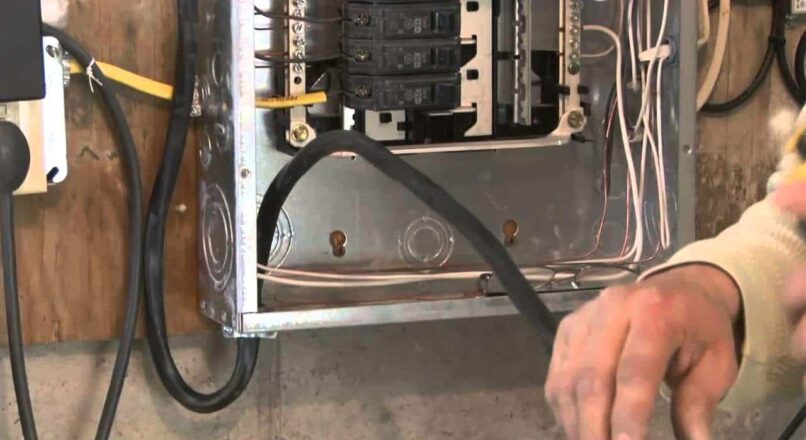
In this how-to install a sub-panel installation I will guide you through the complete installation of a subpanel step by step.
The first question is why are you installing a subpanel. There are either one or two reasons to do this. One because you need more room in your existing panel and in that case if your existing panel is old this would be a great time to just upgrade your current service. Newer 200 amp main panels hold a lot more circuits/breakers.
Two, because you need to bring more power somewhere else like a garage you just built or addition or even in some cases a finished basement. Either way, you want to install a subpanel. Ok. So let’s get going.
First: Where do you plan on placing the new sub-panel? If it’s right next to your main panel that’s one thing, but further away like in that new garage you just built 100 feet away you will certainly want to figure in voltage drop. I can’t get too much into that because every setup would be different.
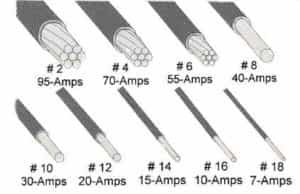
Second: How many amps are you needing for the new sub-panel. So let’s say you need 50 amps. Well, it’s not brain surgery, 50 amp sub panel, 50 amp wire, 50 amp breaker in the existing main panel. See wasn’t that easy.
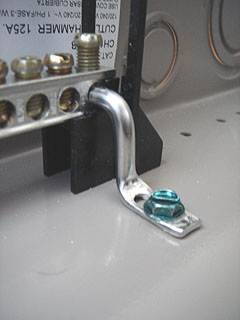
Neutral Bonding Jumper:
This is very very important. This is also known as a bonding screw. It may even be green. This screw is used to bond the neutral coming in the main panel to the case “panel” itself. however, in a sub panel, the neutral bus bar must be totally isolated from the ground. The very first thing the electrical inspector is going to look for is if the sub-panel is bonded or not.
Now as far as wiring the panel. You would wire it just like any other panel. Hot leads to the breakers, grounds to the ground bus bar, and neutrals to the neutral bus bar.
But Why Do You Need To Remove The Green Screw?
Because the neutral only gets bonded at 1st means of disconnect so any unbalanced load only has one true path to the ground and that’s at the power source.
You would install a 220-volt two-pole breaker in the main existing panel. Whatever the amperage is that you’re using. That breaker gets installed in the main panel of course. This is now the main breaker to your sub-panel. By turning this breaker on or off will control the entire subpanel.
Always remember safety first. Turn the main power off before removing panel covers or touching any wires.

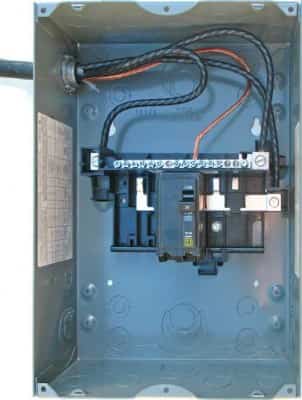
You will need a 4 wire, wire between each panel. No matter how the panel is, this part will always stay the same. You will have two hots, one neutral and one ground. Two hots will go from the new breaker you just installed in the main panel to the sub-panel. A neutral will go from the neutral bus bar in the main panel to the NON bonded bus bar in the sub-panel and ground from the ground bus bar in the main panel to the bus bar in the new sub-panel.

Comments ( 74 )
Dominick,
Excellent video. Very well explained.
I currently have a sub panel in a small barn about 600ft away from the main home/main service panel. Would like to add electric service to another shed which is also about 600 ft away from the main service and about 100 feet from the existing barn/subpanel.
The wire to the sub panel (all installed by an electrician) is underground. It comes up next to the existing barn in a PVC pipe which goes through the barn wall and then to the sub panel. They used an extra thick gauge wire to minimize power loss over the long run.
Is it possible to tap into this and feed another sub panel for a shed? If so, what is the best way?
My thought is to split the line where is comes up to the existing barn using an outdoor junction box. One line would run to the existing barn and a second line would be run to the new shed 100 feet away. (A new trench would be dug for the new wire). I am not sure if this type of splice if permissible.
The other, less preferable solution would be to run a sub panel in the new shed off the existing barn sub panel…. sub panel to sub panel. Again, I’m not sure if this is permissible.
If a new run from the house is needed, the project would be costs prohibitive. I think I could tackle this myself, but may consider an electrician for all/some of the work. Either way, I want to know the “right” way to do it so I make sure an electrician is not taking and shortcuts.
Thanks in advance for any advice you can provide.
This is mainly going to depend on the amp requirements to the shed. However, I would just install a breaker on the barn sup-panel for the new run to the shed.
RE: Grounding rod…
If I install a grounding rod at the shed, would I still run three wires from the sub panel? I am under the impression that I run a ground wired from the panel to the shed, I would not use a grounding rod. If I DO not run a ground wire, I should not use a grounding rod.
Or is it proper to use both a ground wire and a grounding rod?
Thanks,
Yes always use both if it is a separate building.
installing sub panel in pole barn how deep ser cable needs to be buried w/conduit
By code 20″ but I always always go deeper. Go at least 24″ But if you can do 48″ This way you don’t have to worry about where you plant a tree or something like that.
Dominick,
GREAT video! Thank you!
I have a standalone shed and a garage that I want to run 10-3 feeder to. I would connect it to 30A feeder breaker at main panel. The run length will 100′ to the shed, and then additional 50′ to the garage.
Would you recommend I run a single 10-3 and install one subpanel in the shed, one in the garage? Or just one in the shed, and then run 12-2 to the garage with no subpanel in the garage?
Also, I will be putting a ground rod in one or both. Should I not connect the ground wire in the feeder cable then? Seems like I should not.
I really need more power in the garage then shed, because I will be making a workshop there. But shed is closer to the house. Maybe I run the feeder to the garage, and then a 12-2 back to the shed?
Thanks a lot!
You’ll want a bigger wire. Run the sub panel to where you need the most power and a single 12/2 wire for the outlet. And the grounding rod to where the sub panel with the ground from the rod to the sub panel. This is a different wire all together.
Great video! i was following up on a previous question in this thread. Is there any way that it would be allowable to install a feed to a sub panel from a main disconect at a meter panel. This panel has a 200 amp breaker/ disconnect that then goes to panel in garage. Is there a way to piggyback a service wire from the breaker to a new panel?
Thanks!
No really. You would make all connections to main panel to sub panels if needed.
Dominick,
I am installing a sub panel in my garage. I have a 200amp main in my basement and wish to put in a sub panel for 40amp beaker for 220vac socket. I have two different things i wish to install run in my garage and each has a different plug . Can I have two plugs daisy chained through the one breaker. Or do i have to have two breakers one for each two 220vac socket.
Thank you for your advice.
For 220 you’ll need a separate breaker for each.
Great video. Can I use 63UFRL 500 W/GRND underground wire for a sub panel I am putting in a detached Garage. I am going to run it from house to garage about 30 feet and put in a 50 amp breaker in main panel in house.
Thanks
I’ll need more specs on the wire.
have a 200 amp main panel. I’m going to install a 50 amp sub panel with # 6 wire in the next stud bay over. I’ll connect the two with a 2” pvc nipple. I need to move 4 circuits out of main panel into sub panel. Can I run the 4 circuits through the pvc nipple or do I disconnect all 4 circuits out of main panel then install them in sub panel. I’m in Washington state.
Thanks Bill
Really whatever works best for you. Just keep it clean
Dominic my question is I am putting up a 60amp sub panel in my basement where I am going to have a stove which is 40amp and one rangefan and two plugs can I make my feeder breaker 50 or 60amp
60 amp would work but I would also place the stove breaker in the main panel. And this would also depend on the distance.
The sub panel is not bonded. I removed the screw and only has main lugs. Neutral bus bars run up and down both sides. I added a ground bus bar that is attached to the ground/neutral bus bar on the main panel and also to a ground rod. Can’t quite make sense of it. I do have some Commons and ground wires from some 20 and 15 amp circuits both attached to the bonded neutral bars on the 200 amp main panel. Does it matter even though it’s bonded to the ground?
go to the ask questions of this site and post some pictures for me.