
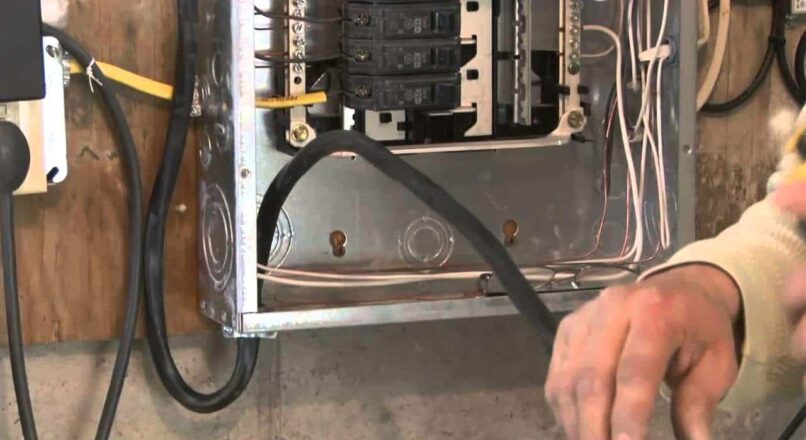
In this how-to install a sub-panel installation I will guide you through the complete installation of a subpanel step by step.
The first question is why are you installing a subpanel. There are either one or two reasons to do this. One because you need more room in your existing panel and in that case if your existing panel is old this would be a great time to just upgrade your current service. Newer 200 amp main panels hold a lot more circuits/breakers.
Two, because you need to bring more power somewhere else like a garage you just built or addition or even in some cases a finished basement. Either way, you want to install a subpanel. Ok. So let’s get going.
First: Where do you plan on placing the new sub-panel? If it’s right next to your main panel that’s one thing, but further away like in that new garage you just built 100 feet away you will certainly want to figure in voltage drop. I can’t get too much into that because every setup would be different.
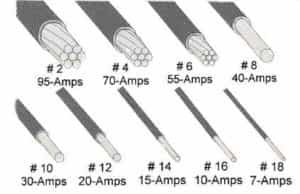
Second: How many amps are you needing for the new sub-panel. So let’s say you need 50 amps. Well, it’s not brain surgery, 50 amp sub panel, 50 amp wire, 50 amp breaker in the existing main panel. See wasn’t that easy.
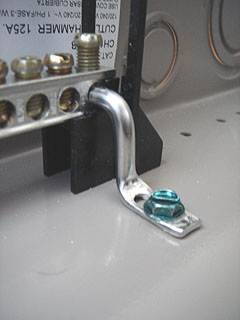
Neutral Bonding Jumper:
This is very very important. This is also known as a bonding screw. It may even be green. This screw is used to bond the neutral coming in the main panel to the case “panel” itself. however, in a sub panel, the neutral bus bar must be totally isolated from the ground. The very first thing the electrical inspector is going to look for is if the sub-panel is bonded or not.
Now as far as wiring the panel. You would wire it just like any other panel. Hot leads to the breakers, grounds to the ground bus bar, and neutrals to the neutral bus bar.
But Why Do You Need To Remove The Green Screw?
Because the neutral only gets bonded at 1st means of disconnect so any unbalanced load only has one true path to the ground and that’s at the power source.
You would install a 220-volt two-pole breaker in the main existing panel. Whatever the amperage is that you’re using. That breaker gets installed in the main panel of course. This is now the main breaker to your sub-panel. By turning this breaker on or off will control the entire subpanel.
Always remember safety first. Turn the main power off before removing panel covers or touching any wires.

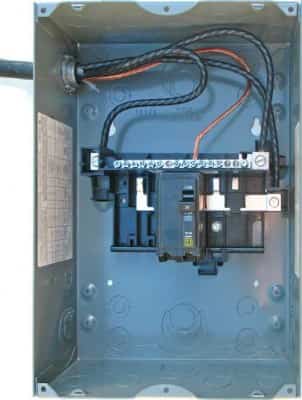
You will need a 4 wire, wire between each panel. No matter how the panel is, this part will always stay the same. You will have two hots, one neutral and one ground. Two hots will go from the new breaker you just installed in the main panel to the sub-panel. A neutral will go from the neutral bus bar in the main panel to the NON bonded bus bar in the sub-panel and ground from the ground bus bar in the main panel to the bus bar in the new sub-panel.

Comments ( 74 )
Hi if the main panel has a main disconnect switch near the meter and that main disconnect switch has neutrals and grounds bonded together and the main panel has seperate grounds and neutrals which are not bonded, how does one go about installing a subpanel? Where does he run his 4 wires to
neutrals are always tied together only the hot legs are switched so you would connect all your wires to the panel either a sub or main.
I built a garage next to my house, it is not attached. I have a 200amp panel in my home with room for more breakers. I installed an 100amp panel in my garage, mainly lights and 110 plug ins with a small hot water heater. My question is can I install a 100 amp breaker in my house panel and run 2/0 wire to the panel in the garage with no problems? Or should I piggy back off the main lugs instead? Thanks Keith
No never piggy back. Other than that it all sounds good. But the wire size will depend on the run. Use this to help with wire size. https://www.askmediy.com/electrical-wire-size-calculator/
Great Video!!! -Question, if the ground and neutral are connected in the main box by the bar and you then connect the ground and neutral from the subpanel to the main box, doesn’t that then also mean the neutral and ground are now connected in the sub panel? I know I’m missing something. :) It may be overkill but I already hammered a rod in so can I also connect the ground? Any safer? Thx
With the sub panel by code the sub panel must be grounded to the main panel unless it’s in a separate structure. Then you would use a grounding rod. The neutral (the return path) will be to the main panel. That’s by code.
Hello and great video. I didn’t find an exact answer to my question.
It has to do with not bonding the neutral and ground on a sub panel.
I have a cabin that I ran 3 wire 2 gauge wire from my main about 300 feet away. I will install a 200 amp sub panel in the cabin along with grounding rods to the panel. Do I still leave the ground and neutral un bonded since I have no ground back to main panel?
Thanks for any help.
Tim
Anything metal is always grounded. The neutral in the sub-panel is isolated (Not bonded)
Thanks, the wire has red and black and white and a ground. I believe I need to separate or have the ground and neutral on separate buss lines and do away with the connecting bar. I also need to ground the box to the ground buss with the clip attached to the green screw in the box. The ground on the main wire from the house acts as the ground but I also need to put in a ground pole outside. I think this is correct and correct me if I am wrong.
Thanks
Yes, any building not attached to the house will need a separate grounding rod.
I install sub in separate building, so I will need 8 feet rod and #6 bare copper coming from the rod to sub grounding bar. Do I need to bring ground from main panel and connect to sub grounding bar as well? If yes, should I use same size as other wires from main?
Another question, are there regulations about location of the grounding rod, how close/far from the building?
Thanks a lot!
You can just install a ground rod at the sub panel building. I’ve always placed them right next to the building within in 12″.
Hi Dominick,
Firstly, Thank you for your contribution to this world.
Do you see any problem with installing an in wall sub panel above a currently installed in wall panel inside a manufactured home? The currently installed indoor panel feeds off of an outdoor main panel if that matters.
I do understand that if I installed a panel above the existing indoor panel that I would have to move the wires coming into the current panel from the top to the new panel i install above it. I just haven’t seen it done anywhere else and wanted to know if you see any possible issues with this.
Hi, I assume you’re talking about a mobile home!. In that case, the first question would do you have enough on the main service for what you’re trying to do?
Can i wire a sub panel from my meter socket, to got to the main panel i will have a lot of digging up to do. is it possible.If yes how to connect? and do i need a seperate earth?
Thanks
No, you must come off of the main panel. If your sub panel is to a separate building you will need a separate grounding rod.
I believe this link solved my delema. Hardware stores must assume the sub pannel (in my case a load box) is in the same structure. Consequently my panel does not include a ground bus. I was told to purchase the bar seperately and connect the ground from the 10-3 direct burial line to it. (about 40 ft to our “unattached” barn structure. I was also told not connect the ground to neutural using the screw included with instructions. Sounds like I need to connect to a seperate grounding bar from comments above. Is it a code violation if I only connecte the ground wire from the main panel to the ground bus?
If it’s your main / only panel then the one bar is used for grounds and neutrals. If you’re installing a sub panel at any location not attached to the building where the main panel is located at then you will have to install a separate grounding rod.
Very nice and instructive video,
We have a fifty foot trailer with a main panel (125A) that feed 2 trailers (1 blue and 1 brown)
I’m working in the blue trailer that is used as a food pantry that help people in the community.
The blue trailer is divided into 2 main rooms (section 1 , section 2)
The blue trailer has an indoor subpanel (70A) that feeds lights and power outlets.
Unfortunately that subpanel 4 circuits of 20 A installed on it with 3 spaces available.
Circuit 1 20A. 1 outlet + lights in section 1 of the trailer.
Circuit 2 20A 2 outlets in section 1 and 1 outlet in section 2
Circuit 3 20A lights in section 2 and light in toilet.
Circuit 4 20 A outside lights.
The main panel is connected to the blue trailer and still has 9 spaces available.
Problem: we have 9 freezers and refrigerators we would like to install in section 2 of the trailer.
At this times we have 6 of those plugged in about 3 outlets, I noticed that 3 refrigerators were in 1 power outlet via extension cord which is a no no although they are each rated at 5 A.
We want to installed dedicated circuits of 20A for this 9 appliances.
The section 2 of the trailer is located about 35-40 feet from the wall where the main panel is located.
The ratings of the appliances:
1 @ 6.5A
2@ 4.0 A
1@ 6 A
4@ 5A
1@ 4.75A
We need your help with this installation.
Thank and surely appreciated.
Why not just add 5 new 20 amp outlets for the above. I would use the 3 available spaces to add 3 20 amps outlets. I’m assuming since it’s a trailer you will have to surface mount all of these using metal boxes and conduit. Look for my adding outlets in a garage.